How Long It Takes to Earn First DevEx Payment From a New Game
The three phases of DevEx payout and why first payments take months.
DevEx, short for Developer Exchange, is the only official way to turn Earned Robux into actual cash. That's the whole pitch, and it's a good one. Most new creators get the timeline wrong: they treat DevEx like a finish line, a single moment where Robux magically becomes money in a bank account. It's actually three separate phases stacked end to end, each with its own pace and its own way of slowing things down. First a creator has to earn enough Robux to clear the minimum. Then the account has to meet a set of eligibility conditions that have nothing to do with how much money was made. Then, after submission, there's a processing and transfer window that runs on its own clock. Knowing the shape of those three phases ahead of time is the difference between planning a launch and just hoping a check shows up.
The 30,000 Earned Robux Minimum and What "Earned Robux" Means
The first gate is 30,000 Earned Robux, and it trips up more first-timers than any other part of the process, mostly because "Earned Robux" doesn't mean what a creator's total balance says it means. Earned Robux counts money that came from actual game activity: game passes, developer products, private server fees, and qualifying payouts from a group whose funds themselves came from legitimate earnings. It does not count Robux bought outright with real money, Robux redeemed from a gift card, Robux granted through a Premium or Plus subscription, Robux transferred in from another account, or proceeds from trading and reselling items a creator didn't make. A player's wallet balance can look healthy and still be nowhere near the threshold once the ineligible Robux gets stripped out. The 30,000 figure maps to a fixed dollar value on the standard DevEx rate table, so the minimum isn't an arbitrary number someone picked out of a hat. It represents a defined floor of real, player-driven game revenue that has to exist before a request can even be opened. Creators who understand this distinction early can track their actual eligible balance from day one instead of discovering the gap the day they try to submit.
How long accumulating 30,000 Earned Robux realistically takes
Of the three phases, accumulating Earned Robux is the one a creator actually has the most control over, and it's also the one with the widest range of outcomes. In an optimistic scenario, a game that catches on fast can clear 30,000 Earned Robux in about a month. For most new games, it takes several months, because monetization can't outrun the basics: players have to find the game, stick around, and spend money, in that order. None of that happens overnight, and none of it happens on a schedule a spreadsheet can predict. Robux earned through game passes and developer products sits in a 28-day hold before it clears into Earned Robux that counts toward the minimum. That means even a game that hits its revenue targets on day one is still looking at a built-in month-long lag before that money is usable for a DevEx request. Plan around the hold, not around the sale.
Eligibility requirements that must be in place before submitting a DevEx request
Clearing 30,000 Earned Robux doesn't unlock anything by itself. A separate set of account-level conditions has to be satisfied, and missing even one of them blocks a submission no matter how large the balance is. Treat eligibility like a checklist running in parallel with game development, not a formality to handle after the fact. A creator who confirms account standing and required documentation in month one of a project avoids the unpleasant surprise of hitting the Robux minimum in month three only to find the request can't go through yet.
After Submission: The DevEx Portal, Tipalti, and the Processing Window
Submitting a DevEx request doesn't end the process. It starts a new one. Once a request goes in, the creator gets invited to register through Tipalti, the payment platform DevEx uses to handle documentation and transfers, and that registration step comes with a hard one-week deadline. Miss it, and the request gets declined and the Robux goes back into the account. That deadline needs to be treated as something to prepare for in advance, with banking and tax documentation ready before the invite even lands, not something to scramble through once the clock starts.
After registration, the payment method chosen determines how long the actual transfer takes. Processing time varies by method and by country. PayPal tends to move faster than ACH transfers or eCheck. Paper check is the slowest standard option, running 7 to 14 business days. Wire transfer runs 1 to 5 business days, a wider range. The name and banking details entered into the portal need to match the creator's bank account information exactly. Mismatches between a name on file and a name on a bank account are one of the most common reasons first payments stall.
Why first DevEx requests consistently take longer than subsequent ones
First-time DevEx submissions tend to run far longer than the official processing estimates suggest, a normal, structural feature of the first request. Community discussion of the process includes a thread documenting a 51-day wait on a first request, along with broader confirmation from other creators that first submissions routinely take significantly longer than later ones. The practical effect compounds with everything already covered: a creator who submits a request in month two of a game's life, after clearing the Robux minimum and the 28-day hold, may not actually see funds land until month three or four. The processing phase alone can tack on a full extra month or more to a first payout. Knowing this ahead of time turns a long wait into an expected part of the process. Filing repeated support tickets during that window won't speed anything up. The timeline moves at its own pace regardless of how many times someone checks on it.
The DevEx Rate and a First Payment's Worth
All that waiting is in service of an actual number, and it helps to know what that number looks like before deciding when to submit. The standard DevEx rate converts Earned Robux to dollars at a fixed per-Robux amount. The 30,000 Robux minimum cashes out to a modest, fixed dollar figure. It's a real payout, just not a life-changing one at the floor. There's a second, higher rate that applies specifically to eligible in-game spending by age-checked adult players in the U.S., and games that attract that demographic can see meaningfully better returns on that portion of their revenue. That enhanced rate is a variable to factor into long-term revenue planning, not a bonus that automatically shows up on a first payment.
One more mechanical detail affects the math: if a rate change happens while a creator is holding a Robux balance, any Robux earned under the prior rate cashes out first, before newer Robux earned under the current rate. Creators sitting on a balance from before a rate change will see a slightly lower effective rate on that older portion. Only one DevEx request is allowed per calendar month, and once submitted, a request cannot be cancelled. That makes timing genuinely strategic. A creator who waits to reach a round number like 100,000 Robux before submitting, instead of cashing out the moment the 30,000 floor is cleared, can meaningfully increase the size of that first payout. The minimum is the floor. The ceiling is just a function of patience.
Tax Classification Change Taking Effect November 1, 2026
A tax classification change takes effect November 1, 2026, and it's relevant to any creator whose first DevEx payment lands on or after that date. DevEx Portal documentation states that DevEx payments will be classified as royalties starting that date, a shift that may affect how U.S. tax withholding gets applied to payments. The documentation directs creators to review and update their tax information in the portal before the change takes effect. This isn't tax advice, and no withholding amount or liability can be stated here with any confidence. The useful move for a creator whose timeline lines up near or after November 2026 is to update tax information in the portal well ahead of time, rather than leaving it until a Tipalti registration invite shows up with a one-week clock already running. For anything beyond updating the portal, a tax professional is the right call, not a guess.
Compressing the Timeline: Genre, Monetization Design, and AI-Assisted Creation
The accumulation phase is the biggest variable in the whole timeline. It's also the biggest lever a creator can pull to shorten it. Two decisions matter more than anything else here: what genre to build, and how the game actually makes money. Games with short core loops and monetization built into the design, tycoons, single-loop simulators, themed obbies with a clear game-pass plan, tend to generate Earned Robux on a far more predictable schedule than open-world or exploration-style experiences with no obvious moment where a player decides to spend. An obby is the fastest type of game to actually build, but it's also the hardest to monetize if the game-pass plan gets bolted on after launch instead of designed in from the start.
AI-assisted creation tools, including platforms like studs.gg, can meaningfully speed up the pre-launch phase: building, iterating, and shipping a playable game faster than building everything by hand. That's a genuine advantage for a solo creator or a small team working against the clock. What those tools can't do is manufacture players. Discovery and retention sit outside what any creation tool controls, and a game built in record time still has to compete for algorithmic placement against millions of other experiences. The accumulation timeline is ultimately driven by player hours, not by how fast the game got made. Faster creation buys a creator more shots at the discovery lottery. It doesn't buy a win.
A realistic end-to-end timeline from game idea to first payment in hand
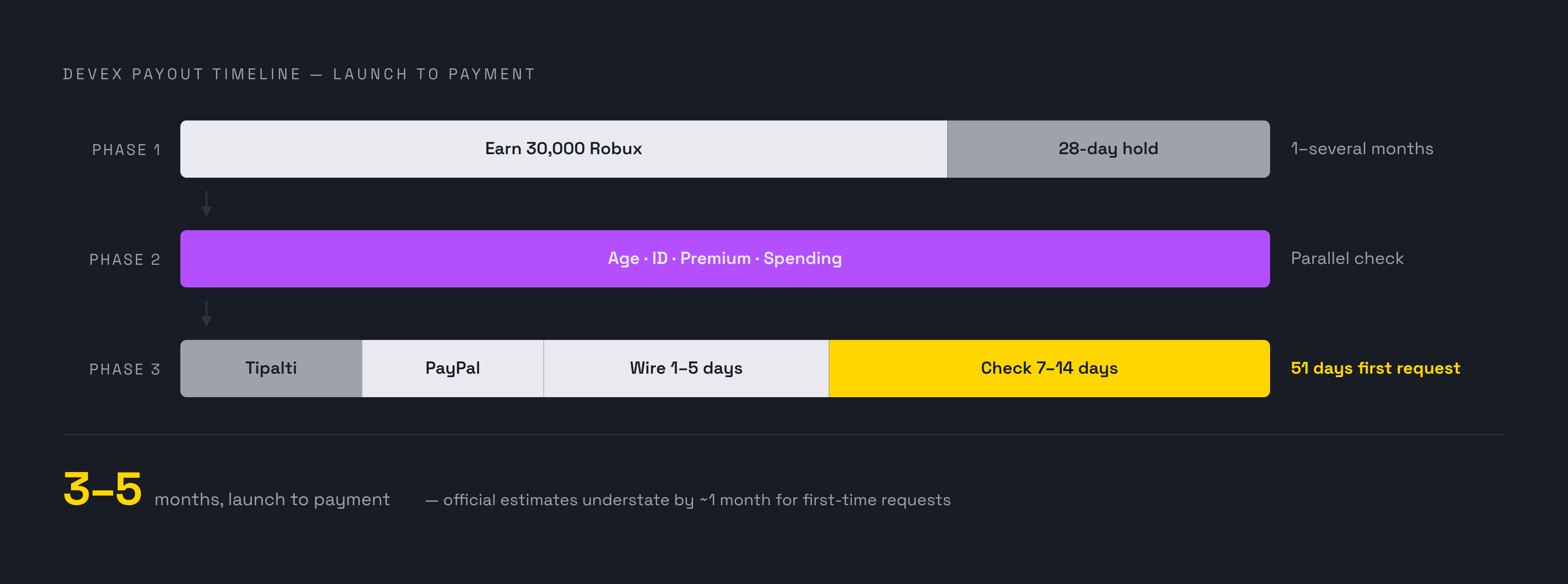
Putting all three phases together gives a usable planning range. In the optimistic scenario, a creator builds a game with strong monetization design, clears the 30,000 Robux minimum in about a month, has eligibility and documentation already sorted in parallel, and moves through registration and transfer without delay. That path lands a first payment in roughly 30 to 60 days from launch, assuming nothing snags along the way. The more typical scenario stretches out further: several months to earn the minimum once discoverability and retention are factored in, a 28-day hold on earnings as they clear, a first-submission processing window that commonly runs well past official estimates (the 51-day thread being a documented example), and a payment method that adds its own handful of business days on top. Stacked together, a realistic first-time timeline often runs three to five months from the day a new game goes live to the day money actually lands. Genre choice, monetization design, and getting eligibility paperwork done early are the only levers that shorten that window. Everything else is a matter of waiting out a process that, once understood, a creator can actually plan around.