VIP Server Game Passes vs Standard Game Passes
Standard game passes sell permanent perks, while private servers sell control over your own session.
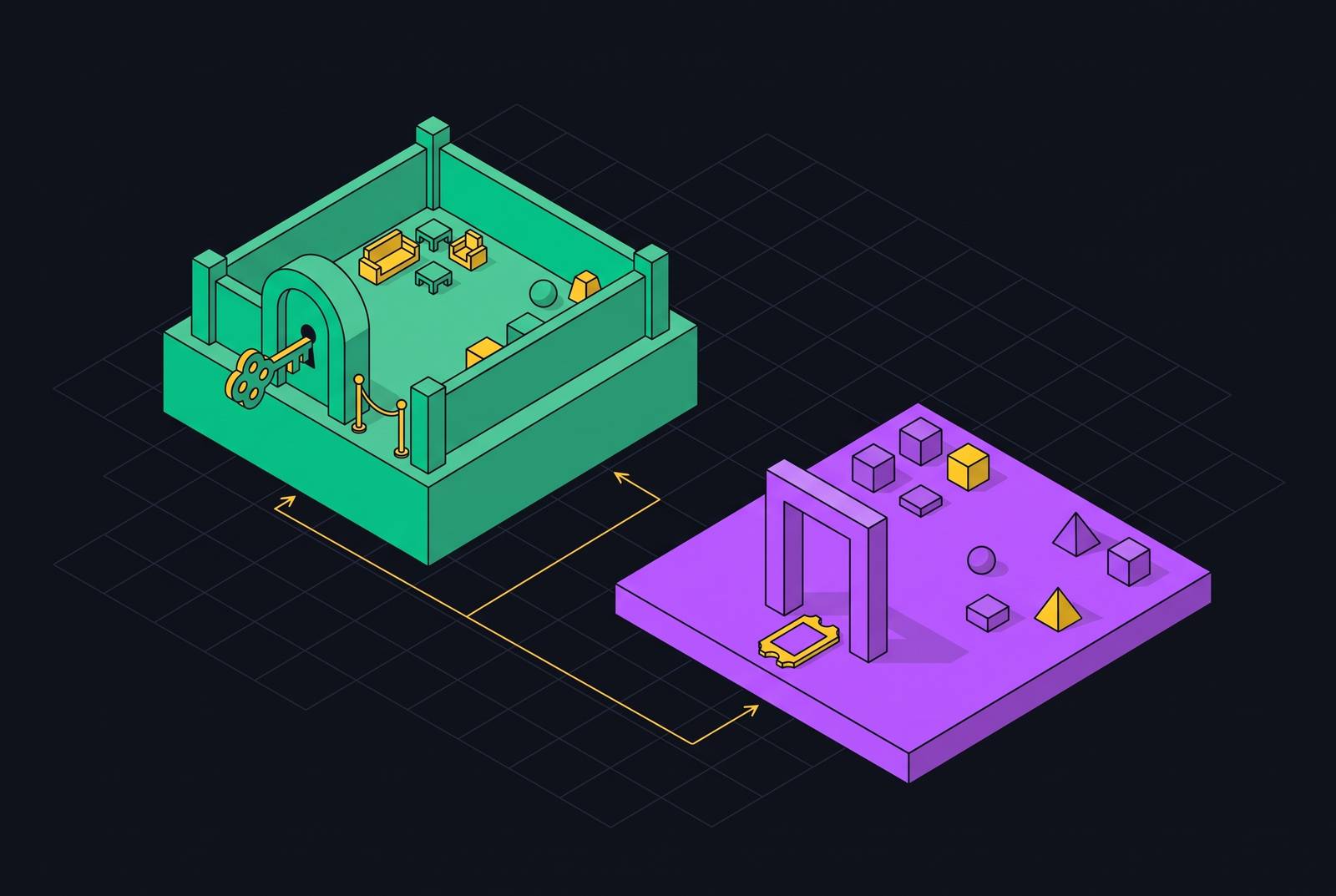
VIP Server passes and standard game passes get lumped together constantly, because the confusion traces back to a naming accident. The word "VIP" appears in both names, which is the whole problem. A standard game pass can be branded a "VIP pass" and sell an in-game perk, a colored name, a speed boost, access to a locked room. Meanwhile, a VIP Server was the platform's original name for something else entirely: a recurring subscription that hands a player control over a private, invite-only version of a game. That product got renamed to Private Server a while back, and the new name is more honest about what's actually for sale. Once both terms are on the table, the rest of this gets a lot easier to follow. A game pass sells a capability. A Private Server subscription sells control over the session itself. Those are two different commercial objects that happen to share a label, the way "bank" means both a riverbank and the place that holds your money. Nobody confuses those two. Creators should stop confusing these.
How product structure shapes player purchases
Different products, different reasons to open the wallet. A standard game pass is a one-time purchase with permanent effect: pay once, own it forever, and the value shows up every time the player logs into a public session. That value might be social (a VIP chat tag, a colored name), mechanical (extra speed, a better tool, access to an exclusive area), or purely cosmetic. Brookhaven RP's 275 Robux Premium Pass grants a narrower slice of the same kind of content as its pricier packages, which is a clean illustration of how creators stack multiple passes to catch buyers at different price points within one experience.
A Private Server subscription runs on a completely different clock. The player pays again every month to keep the lights on in their own private instance, buying the ability to control who gets in, shut out PvP interference, manage spawn timing, and keep the guest list to a fixed group of friends. Blox Fruits prices its private server as a monthly Robux subscription, and the players buying it are deep in an RPG grinding loop, paying to keep their environment free of randoms. One product raises a player's standing or power inside a shared world. The other buys a room with a lock on the door. Neither is better.
The revenue mechanics each product creates for the creator
Flipping the lens to the creator's side of the ledger reveals two very different revenue models. A standard game pass earns on conversion: the creator gets paid once per player who decides to buy, full stop, and the price has to reflect the perk's entire lifetime value at the single moment someone clicks "buy." A player staring down a 999 Robux price tag is weighing permanent value, not a monthly bill, so that first impression carries all the weight.
A Private Server subscription earns differently. It pays out on recurring renewal, giving the creator something close to a subscription revenue stream for as long as the player keeps the private server active. That smooths income out over time, but it also means the creator has to keep justifying the monthly cost, month after month, or the subscriber just lets it lapse. There's no refund drama when that happens either. The player simply loses access, with no permanent entitlement to reclaim later, unlike a game pass perk that sticks around forever after one purchase.
These two models aren't rivals fighting for the same dollar. Jailbreak runs both at once: a standard one-time VIP game pass alongside a recurring monthly subscription layer, each one pulling revenue from a different kind of player. Running both means a single game can have two different customers with two different reasons to pay.
Why the right choice depends on game genre and player behavior
Standard game passes don't win by default. The genre a creator builds in does most of the work deciding which product actually performs. Conventional wisdom puts standard game passes first for most titles, and that holds up well in simulators and tycoons, where players are already deeply invested in long-term progression and are happy to pay once for a permanent multiplier or an exclusive area. Session length is long, players come back constantly, and a permanent advantage pays for itself many times over across that relationship. That's the genre game passes were built for.
But that "passes first" instinct gets shaky in genres with short sessions and low impulse spending, like obbies and casual platformers. A player who'd never drop 500 Robux on a permanent obby perk might happily pay a small monthly fee for a private server to run with friends on a Saturday. The value there is social and situational, not mechanical and permanent, and no amount of pass-stacking fixes that mismatch.
RPG and grind-heavy games lean hard toward private servers for a related reason: environment control is worth the most exactly when a game's core loop rewards long, uninterrupted sessions. Blox Fruits again makes the case directly. Its private server subscription fits an RPG grinding loop where cutting out interference speeds up progression in a way no public-lobby perk could match.
Roleplay and social games sit on the other end of that spectrum. Standard passes do well there because the entire point is visibility to other players. Exclusive items, name colors, spawn privileges, all of it only matters because other people in the public server can see it. Brookhaven RP's tiered pass lineup is built entirely on that social-display logic, and it works because the genre's whole appeal is being seen.
The pay-to-win risk standard game passes carry in public lobbies
A standard game pass that sells speed, damage, or exclusive weapons inside a shared public lobby creates a problem that has nothing to do with revenue and everything to do with how the other players in that lobby feel about the game. Every non-paying player in that session is now playing against an edge they can't access, and that perception costs a creator something real in retention, even when the pass itself sells well.
Private Server subscriptions don't carry that baggage. Because the benefits stay contained inside the subscriber's own private instance, nobody in a public lobby is disadvantaged by someone else's monthly payment elsewhere. The competitive balance of the public game stays intact, untouched by what happens behind anyone's private door.
Outlaster's history shows one way creators have already engineered around this tension structurally. The game originally bundled a range of perks with different pay-to-win implications into one monolithic VIP pass. In a March 2022 update, it split that single pass into five: the VIP pass, the Free Advantage Pass, the Currency Pass, the Free Item Pass, and the Hosting Permissions Pass. That breakup let players buy only the specific perks they wanted, while giving the creator a lot more control over which advantages were allowed to touch public lobbies. It's a design fix, not a moral one, showing the problem has a workable answer that doesn't require giving up on game passes.
How AI-assisted game creation raises the stakes of this monetization decision
The barrier to publishing a game has dropped fast, and that changes when the monetization decision actually has to get made. Creators building on AI-assisted platforms can go from a rough concept to a published, playable game in roughly an hour. That speed is a gift and a trap at the same time: it means a creator now has to decide between a game pass and a private server subscription before they've collected any playtesting data that would normally inform that call.
Getting this wrong at the start raises the cost of fixing it later. A creator who treats a VIP Server pass as just a fancier version of a standard game pass, rather than recognizing it as a structurally different recurring subscription product, ends up building their monetization layer around the wrong model from day one. Retrofitting that after launch is possible, but it costs early player retention along the way, and early retention is what a new game can least afford to lose.
Paralov is built for this creator profile. It's a browser-based AI game creation platform that handles design, 3D building, scripting, and testing from a plain-text description, with no installation and no prior development background required. It covers the genres this whole decision depends on, from tycoons, obbies, and simulators to shooters and horror experiences, which happen to be the same genres where picking the right pass type does the most work shaping revenue. Creators choosing between one-time conversion and recurring revenue need to know not just which model tends to perform better in their genre, but whether their game's scope even supports the strategy they're leaning toward, and the fastest way to find that out is building a rough version of both and watching what players actually do. Shipping a playable version of a concept in about an hour makes it realistic to test monetization hypotheses early, instead of locking in a single revenue model months into a build and hoping the genre cooperates.
A practical decision framework for choosing between the two pass types before you build
Choosing between a standard game pass and a Private Server subscription is a game-design decision before it's ever a monetization decision, and the right call comes from the session structure and social context of the experience rather than some abstract ranking of which product earns more. A standard game pass fits best where sessions run long and players return often, like tycoons, simulators, and RPGs with active public lobbies, and where the perk's appeal is social visibility or public-lobby differentiation. It also fits where a creator wants to capture a player's willingness to pay in one clean conversion event, and where stacking multiple passes at different price points makes sense for sorting buyers by budget, the way Brookhaven RP does with its 999 Robux VIP Pack and 275 Robux Premium Pass sitting among more than 15 total passes, and the way Outlaster does with its five-pass lineup.
A Private Server subscription fits best where the value on offer is control over the environment, bought by someone organizing a session for friends. It suits a creator who wants steady recurring revenue over a single conversion spike, and it suits genres that are grind-heavy or social, like RPGs, roleplay, and cooperative play, where a controlled private instance has obvious functional value beyond bragging rights. Some player bases genuinely split into two distinct groups, competitive solo players chasing public-lobby perks and social organizers who want a private room to call their own, and in that case running both products side by side makes sense, the way Jailbreak pairs a standard VIP pass with a recurring subscription layer.
One guardrail applies no matter which path a creator takes: any perk granting a mechanical edge inside a shared public lobby creates pay-to-win friction, so keeping those advantages locked inside private instances, or limiting public-lobby passes to cosmetic and social perks like chat tags, name colors, and spawn privileges, protects the experience for everyone who hasn't paid and protects the creator's retention numbers right along with it.